
Environmental science is the interdisciplinary study of processes that shape our environment. Drawing principally from the areas of oceanography, geology, and meteorology, the environmental science program at FSU prepares students in the broader area of geosciences and is an attractive option for those seeking a broader interdisciplinary major.
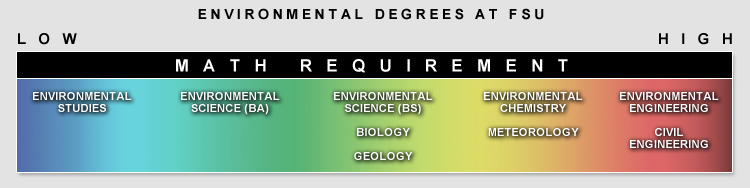
The environmental science program at the FSU Department of Earth, Ocean, and Atmospheric Science offers both a B.A. and B.S. degree. The goals of these programs are to prepare exceptionally well-qualified graduates to work in the interdisciplinary earth sciences, whether in government agencies, non-governmental organizations or the private sector. They also provide a strong basis for graduate study in environmental and interdisciplinary earth sciences, also offered in the EOAS department. The B.A. degree differs from the B.S. degree in lower-level mathematics requirements and a greater emphasis on policy.
Even in the short duration of this degree, our alumni have joined organizations within the state of Florida such as the Florida Fish and Wildlife Conservation Commission and out of state governmental agencies such as the Department of Energy.
B.A. or B.S. in Environmental Science
- The Program Guide provides the environmental science degree requirements.
- The Academic Map provides a term-by-term sample course schedule for earning a degree in environmental science.
B.A. or B.S. in Environmental Science and Policy
- The Program Guide provides the environmental science and policy degree requirements.
- The Academic Map provides a term-by-term sample course schedule for earning a degree in environmental science and policy.
Note: B.S. in FSU-Teach (Environmental Science) was discontinued Fall 2025.
Environmental Science
A minimum of 15 semester hours of environmental science courses approved for major credit as follows:
Two of the following: MET 1010 (or MET 2700), GLY 2010C or OCE 4008 and any three courses from the environmental science elective.
Environmental Science and Policy
A minimum of 15 semester hours which must include two of the following:
MET 1010 (or MET 2700), GLY 2010C or OCE 4008, and any two courses from the environmental science and policy electives and one class from the required policy courses.
Career Advice
It’s important to consider what kind of career you would like to pursue with your environmental science degree. Ask yourself if you want to go to graduate school, work for a government agency, or work for a non-governmental organization and what type of work you want to do. For example, do you want to pursue field or laboratory research, do you want to pursue field or laboratory research, do you want to be the one asking the research questions or the one carrying out the research, do you want to work in policy, law, or science? Look at the requirements of jobs and graduate programs that interest you to help you plan what courses to take, skills to acquire, and experiences to gain over your next four years. Provided below are opportunities and goals that will help you stand out from other job or graduate school applicants and increase your chances of being hired or accepted. It’s important to read through this information early in your time at college, so that you can put yourself on a path that will lead to the career you want. And be sure to periodically ask yourself if your end goal is still the same as when you started and if it’s not, then adjust your path to better prepare yourself.
Graduates with an environmental science degree are placed in a variety of fields and jobs. Some work at the U.S. Environmental Protection Agency and with the Florida Department of Environmental Protection or other state or federal agencies, such as the Florida Fish and Wildlife Conservation Commission or the National Oceanographic and Atmospheric Administration. There are a multitude of environmental consulting firms that hire environmental scientists for filed, lab and modeling projects. Students may go into the education field, including K12 education, museums or other outreach settings, or curriculum development. Environmental writing or publishing is also an option. Students who receive their bachelor’s degree in environmental science can prepare themselves for graduate study in a related field such as law, public health, business or the sciences. Listed below are links to lists of graduate-level environmental science programs:
Focus and Specialize
Environmental science is a broad field, like a wide, shallow river. It is up to you to develop a skillset for yourself. This skillset represents a deep spot in your education where you have a high degree of competence, expertise or specialty to offer employers. This specialty helps make yourself unique and stand out. It is your responsibility to yourself to find the area that catches your interest the most and develop your skills in that area. As one environmental science graduate who now heads a group at the US-EPA put it, with an environmental degree “if you know what you’re doing, you can land anywhere.” Learn yourself so you know what you are doing.
For more information on planning for a career in environmental science, visit environmentalscience.org
Skills
It’s important to develop a focus, a deep knowledge of a skill that will make you more attractive as a job candidate. Examples include programming (learn a language), geographic information systems (GIS) experience, database management, statistics, field experience, surveying, chemistry analytical techniques, electronics, proficiency with operating and maintaining a piece of advanced laboratory equipment (ex. mass spectrometry), and learning how to use an advanced piece of software such as AutoCAD. Other possibilities include classes at the engineering school such as Into to Environmental Engineering Science, Environmental Engineering Science Lab, Computer Graphics Engineering, Civil Engineering Graphics Lab, Site Investigation (teaches surveying techniques) or Engineering Mechanics. Specialize in one of the three disciplines: geology, oceanography or meteorology. If you want to go to graduate school in the sciences, load up on calculus, chemistry and physics.
Internships
These experiences will build your marketability and expertise in your field and help you determine if you like the subject and type of work. It will also let you meet people in the field, so you can make connections that may become helpful further down the road. Another advantage of internships is that you gain a referee that probably has spent more time with you than your professors and can speak to your abilities outside the classroom.
On-Campus Experience
Similar to internships, volunteering/working in a lab on campus will build your experience and develop a relationship with a prospective referee. If you start working in a lab on campus early in your time at FSU (first or second year), there are potentially more opportunities available to you within that lab. This can include earning more responsibilities, learning more skills, and potentially working on an individual project; all of these make you more attractive to future employers/advisors.
Professional Societies
Look at professional societies in your area of interest and consider joining as a student member. Professional societies commonly have discounted student rates that provide you with access to the society’s scientific journal and valuable resources such as forums that post internship and job opportunities. You may also consider attending the society’s conference. Attending a scientific conference will give you a front-row seat to the scientific process and provide the opportunity to meet other students and professionals in the field.
Certifications
Depending on the specific field you are interested in, there are certifications that might make you more attractive to prospective employers/advisors. For example, if you want to work with environmental containments a HAZWOPER (Hazardous Waste Operations and Emergency Response) certification may help, or if you want to do field work that involves a boat, you may want to get a boat safety course certification.
Reference Letters
Someone who knows you will be better equipped to write a strong reference letter for you. As mentioned above, internships and working in a lab on campus are both great ways to let someone get to know you better. In large classes, it can be difficult for a professor to get to know you well and the professor will have little information on which to base a reference letter. Going above and beyond the requirements of a class, or volunteering for extra activities or projects, will go a long way in helping a professor get to know you better and providing the professor with detailed examples that strengthen reference letters.
Curriculum Vitae (CV)
CV’s or résumés summarize your work and educational experiences for prospective employers/advisors. It’s not uncommon for CVs to be used as a way to quickly cut down an applicant pool, so it is very important to put a lot of time into your CV. Make sure it is easy to read/navigate, accurate, and perfectly formatted. FSU’s career center has a website with guidelines and tips for writing your CV. Additionally, the career center will review your CV for you and also offers mock interviews.
How to Find Jobs
Programs for recent graduates:
Below are websites to search for environmental science job postings; this is only a basic list, there are certainly more resources out there. It’s also a good idea to look at society websites for your particular interests. For example, the Association for the Sciences of Limnology and Oceanography website and the Society for Marine Mammalogy have job posting sections for members. Additionally, society forums are also useful places to search for job postings. Keep in mind that jobs with small nonprofit organizations, environmental consulting agencies, and other organizations might not be part of any job search engines. If you have a specific location in mind, try looking at the businesses/attractions in that area; for example, local zoos/aquariums, environmentally friendly landscaping companies, air quality specialists, media outlets (environmental reporting), and schools (teaching environmental science). Also, ask teachers, graduate students, friends, family, and acquaintances in your specific field of interest for organizations to consider.
- Conservation Job Board
- Greenjobsearch.org
- Florida Fish and Wildlife Conservation Commission
- Florida Department of Environmental Protection
- Usajobs.gov — includes all federal government job postings including places like the EPA and the National Parks Service
Job Outlook and Statistics
View stats on environmental scientists and specialists from the United States Department of Labor, Bureau of Labor Statistics.
Environmental scientists and specialists need at least a bachelor’s degree in natural science for most entry-level jobs and use their knowledge of the natural sciences to protect the environment. They identify problems and find solutions that minimize hazards to the health of the environment and the population. They work in offices and laboratories. They may also spend time in the field gathering data and monitoring environmental conditions firsthand. Most environmental scientists and specialists work full-time. The median annual wage was $80,060 in 2024.
Employment of environmental scientists and specialists is projected to grow by 4 percent from 2024-2034, about as fast as the average for all occupations. About 8,500 job openings are projected each year, on average, over the decade.
Rochelle Arrington
First-years and sophomores
EOA 3008A
rarrington@fsu.edu
850-644-8582
Austin Hardy
Juniors and seniors
EOA 3011
ahardy2@fsu.edu
850-644-8580